
Bağımsızlık etiketine sahip kayıtlar gösteriliyor. Tüm kayıtları göster

24 Kasım 2007

Devrimler*.. Dostoyevsky/MUHAMMED/ATATÜRK

* * *
Ekim Devrimi

Proleterya Devrimi, İşçi Devrimi
"Tarihte her ne olmuşsa,
başka türlü olamadığından öyle olmuştur."
Karl Marx

"
Adamlar
haklı veya haksız,
bir sisteme başkaldırıyorlar.
Sana, bana, şuna, önüne gelene
sistemin fenalığını
anlatıyorlar.
Güçlenmeye, taraftar kazanmaya
çalışıyorlar.
Ah keşke bir de dinsiz olmasalar.
Onların dinsiz olmasında kilisenin hiç mi suçu yok?
Kilise sisteme arka çıkmasa veya en azından tarafsız olsa.
Ah Çar Hazretleri,
sarayından çık!
Kenar mahallelerde şöyle bir dolaş!
Gör ne sefalet ne çirkinlikler var.
İnsanlarla köpekler yan yana yatıyorlar.
Bir lokma ekmek için
namuslar
satılıyor.
"Umumî saadet" ha!..


Çar II.Nikolay

Kokuşmuş ve hastalık halini almış sistemi

değiştirmek dahilerin işidir.
Muhammed
sistemi
zorlayacak ve devirecek güce
erişinceye kadar putlara dokundu mu?
Sistemi ezip ayakları altına aldıktan sonradır ki
putları devirdi.
Neden?
Putlar bir semboldü.
Ben ne yaptım?
Sembolden, yani kocakarıdan (tefeci kadın) işe başladım.
Bir engeli aşmak istedim.
Ama aşamayıp gerisinde kaldım.


Dostoyevsky
1821 - 1881

Ruha Dokunan Düşünceler
hazırlayan: Esra Uluç
carpe diem Kitap


TIME, MARCH 1923
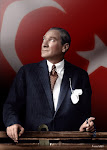
Mustapha Kemal Pasha
1881 - 1938

ULUSAL HALK DEVRİMİ

_/ 23 Nisan 192o'de kurulan
Türkiye Büyük Millet Meclisi
ile
Yaşamaya Devam Ediyor
_/
AYHAN GÖRÜR


"


NUTUK - SÖYLEV

" Bağımsızlığı için

ölümü göze alan ulus,
insanlık onur ve şerefinin gereği olan her özveriye
başvurduğunu düşünerek avunur ve elbette,

tutsaklık zincirini kendi eliyle boynuna geçiren
uyuşuk, onursuz bir ulusla


karşılaştırılınca,
dost ve düşman gözündeki yeri çok başka olur.
Sonra,
Osmanlı hanedanını ve saltanatını
sürdürmeye çalışmak,
elbette
Türk ulusuna en büyük kötülüğü yapmaktı.
Çünkü ulus,
her türlü özveriye baş vurarak
bağımsızlığını sağlasa da,
padişahlık sürüp giderse,
bu bağımsızlık güvenli sayılamazdı.
Artık yurtla, ulusla
hiçbir vicdan ve düşünce bağı kalmamış
bir sürü delinin,
devlet ve ulus bağımsızlığının ve onurunun
koruyucusu durumunda bulundurulması
nasıl uygun görülebilirdi?
Halifeliğe gelince, bunun
bilim ve tekniğin ışığa boğduğu uygarlık dünyasında
gülünç sayılmaktan başka
bir durumu kalmış mıydı?
Osmanlı hükümetine, Osmanlı padişahına ve
müslümanların halifesine
başkaldırmak
ve bütün ulusu ve orduyu
ayaklandırmak
gerekiyordu. "

Mustafa Kemal ATATÜRK


Türkiye Büyük Millet Meclisi
23 Nisan 1920

Derleyen: Ayhan Görür

29 Ekim 2007

Ya İstiklâl, Ya Ölüm ! - Therefore, Independence or Death !...ATATÜRK


* * *
Özgürlük benim karakterimdir.
Mustafa Kemal Atatürk

Ya istiklâl, ya ölüm !
Therefore, Independance or Death !


Nutuk
,,
Temel ilke, Türk ulusunun onurlu ve şerefli bir ulus olarak yaşamasıdır. Bu, ancak tam bağımsız olmakla sağlanabilir. Ne denli zengin ve gönençli olursa olsun, bağımsızlıktan yoksun bir ulus, uygar insanlar karşısında uşak durumunda kalmaktan kendini kurtaramaz.

Yabancı bir devletin koruyuculuğunu istemek
insanlık niteliklerinden yoksunluğu, güçsüzlüğü ve beceriksizliği açığa vurmaktan başka bir şey değildir. Gerçekten bu aşağılık duruma düşmemiş olanların, isteyerek başlarına bir yabancı yönetici getirmeleri hiç düşünülemez.

Oysa, Türkün onuru ve yetenekleri çok yüksek ve büyüktür. Böyle bir ulus, tutsak yaşamaktansa yok olsun, daha iyidir.

Öyleyse, ya bağımsızlık, ya ölüm !

İşte gerçek kurtuluşu isteyenlerin parolası bu olacaktı.

Bir an için, bu kararın uygulanmasında başarısızlığa uğranılacağını düşünelim. Ne olacaktı ?
Tutsaklık.

Peki efendim, öteki kararlara uymakla da sonuç bu olmayacak mı ?

Şu ayrımla ki, bağımsızlık için ölümü göze alan ulus, insanlık onur ve şerefinin gereği olan her özveriye baş vurduğunu düşünerek avunur ve elbette, tutsaklık zincirini kendi eliyle boynuna geçiren uyuşuk, onursuz bir ulusla karşılaştırılınca, dost ve düşman gözündeki yeri çok başka olur.
,,


Freedom is my character!

A
SPPEECH
delivered by
GHAZI
MUSTAPHA KEMAL
"ATATÜRK"
in
OCTOBER 1927
NUTUK

Translated by Dr. Mim Kemâl ÖKE
,,

The main point was that the Turkish nation should be free to lead a worthy and glorious existence. Such a condition could only be attained by complete independence. Vital as cosiderations of wealth and prosperity might be to a nation, if it is deprived of its independence it no longer deserves to be regarded otherwise than as a slave in the eyes of civilised humanity.

To accept the protectorate of a foreign Power would signify that we acknowledge that we lack all human qualities; it would mean that we admit our own weakness and incapacity. Indeed, how could we make people understand that we can accept a foreign master if we have not descended to this degree of abject servitude?

But the Turk is both dignified and proud; he is also capable and talented. Such a nation would prefer to perish rather than subject itself to the life of a slave.

Therefore, Independence or Death !

This was the rallying cry of all thos who honestly desired to save their country.

Let us suppose for a moment that in trying to accomplish this we had failed. What would have been the result?
- why, slavery!

In that case, would not the consequence have been the same if we had submitted to the other proposal?

Undoubtedly, it would; but with this difference, that a nation that defies death in its struggle for independence derives comfort from the thougt that it had resolved to make every sacrifice compatible with human dignity.

There is no doubt whatever that in the eyes of both friend and foe throughout the world its position is more respected than would be that of a craven and degraded nation capable of surrendering itself to the yoke of slavery.
,,


Ghazi Mustapha Kemal "ATATÜRK"

Yaşama,
ölümün kaldıramayacağı bir anlam yüklemek
her inancın özünü oluşturur.

Tolstoy


Derleyen: Ayhan Görür

24 Şubat 2007

El Libertador...Mustafa Kemal Atatürk - Simon Bolivar


Hello, from Turkey!

Freedom is my character!
The peace at home, peace at the World!

Özgürlük benim karakterimdir!

Yurtta barış, dünyada barış!

El Libertador
Mustafa Kemal ATATÜRK


El Libertador
Simon Bolivar

Simón José Antonio de la Santísima Trinidad Bolívar was born in Caracas on July 24, 1783, to don Juan Vicente Bolívary Ponte and doña Maria de la Concepción Palacios y Blanco. An aristocrat by birth, Simón Bolívar received an excellent education from his tutors, especially Simón Rodríguez. Thanks to his tutors, Bolívar became familiar with the works of the Enlightenment as well as those of classical Greece and Rome.
By the age of nine, however, Bolívar lost both his parents and was left in the care of his uncle, don Carlos Palacios. At the age of fifteen, don Carlos Palacios sent him to Spain to continue his education.
Bolívar left for Spain in 1799 with his friend, Esteban Escobar. En route, he stopped in Mexico City where he met with the viceroy of New Spain who was was alarmed with the young Bolívar argued with confidence on behalf of Spanish American independence. Bolívar arrived in Madrid on June of that same year and stayed with his uncle, Esteban Palacios.
In Spain, Bolívar met Maria Teresa Rodríguez del Toroy Alaysa whom he married soon afterwards in 1802. Shortly after returning to Venezuela, in 1803, Maria Teresa died of yellow fever. Her death greatly affected Bolívar and he vowed never to marry again. A vow which he kept for the rest of his life.
After losing his wife, Bolívar returned to Spain with his tutor and friend, Simón Rodríguez, in 1804. While in Europe he witnessed the proclamation of Napoleon Bonaparte as Emperor of France and later the coronation of Napoleon as King of Italy in Milan. Bolívar lost respect for Napoleon whom he considered to have betrayed the republican ideals. But it was in while in Italy that Bolívar made his famous vow atop Mount Aventin of Rome to never rest until America was free.
Bolívar returned to Venezuela in 1807 after a brief visit to the United States. In 1808 Napoleon installed his brother, Joseph, as King of Spain. This launched a great popular revolt in Spain known as the Peninsular War. In America, as in Spain, regional juntas were formed to resist the new king. Unlike the Spanish junts, however, the American juntas fought against the power of the Spanish king, not only the person of Joseph Bonaparte.
That year, the Caracas junta declared its independence from Spain and Bolívar was sent to England along with Andrés Bello and Luis López Mendez on a diplomatic mission. Bolívar returned to Venezuela on June 3, 1811, and delivered his discourse in favor of independence to the Patriotic Society. On August 13 patriot forces under the command of Francisco de Miranda won a victory in Valencia.
On July 24, 1812, Miranda surrendered after several military setbacks and Bolívar soon had to flee to Cartagena. From there, Bolívar wrote his famous Cartagena Manifesto in which he argued that New Granda should help liberate Venezuela because their cause was the same and Venezuela's freedom would secure that of New Granada. Bolívar received assistance from New Granada and in 1813 he invaded Venezuela. He entered Merida on May 23 and was proclaimed "Libertador" by the people. On June 8 Bolívar proclaimed the "war to the death" in favor of liberty. Bolívar captured Caracas on August 6 and two days later proclaimed the second Venezuelan republic.
After several battles, Bolívar had to flee once more and in 1815 he took refuge in Jamaica from where he wrote his Jamaica Letter. That same year, Bolívar traveled to Haiti and petitioned its president, Alexander Sabes Petión, to help the Spanish American cause. In 1817, with Haitian help, Bolívar returned to the continent to continue fighting.
The Battle of Boyaca of August 7, 1819 resulted in a great victory for Bolívar and the army of the revolution. That year, Bolívar created the Angostura Congress which founded Gran Colombia (a federation of present-day Venezueal, Colombia, Panama, and Ecuador) which named Bolívar president. Royalist opposition was eliminated during the following years. After the victory of Antonio José de Sucre over the Spanish forces at the Battle of Pichincha on May 23, 1822, all of northern South America was liberated. With that great victory, Bolívar prepared to march with his army across the Andes and liberate Peru.
On July 26, 1822, Bolívar met with José de San Martín at Guayaquil to discuss the strategy for the liberation of Peru. No one knows what took place in the secret meeting between the two South American heroes, but San Martín returned to Argentina while Bolívar prepared to fight against last Spanish bastion in South America.
In 1823 Bolívar took command of the invasion of Peru and in September arrived in Lima with Sucre to plan the attack. On August 6, 1824, Bolívar and Sucre jointly defeated the Spanish army in the Battle of Junín. On December 9 Sucre destroyed the last remnant of the Spanish army in the Battle of Ayacucho, eliminating Spain's presence in South America.
On August 6, 1825, Sucre called the Congress of Upper Peru which created the Republic of Bolivia in honor of Bolívar. The Bolivian Constitution of 1826, while never enacted, was personally written by Bolívar. Also in 1826, Bolívar called the Congress of Panama, the first hemispheric conference.
But by 1827, due to personal rivalries among the generals of the revolution, civil wars exploded which destroyed the South American unity for which Bolívar had fought. Surrounded by factional fighting and suffering from tuberculosis, El Libertador Simón Bolívar died on December 17, 1830.

Simon Bolivar

Derleyen: Ayhan Görür